
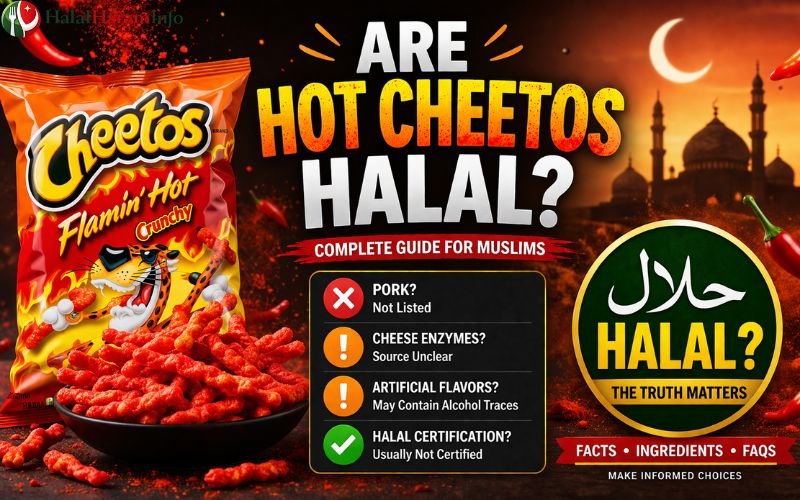
Hot Cheetos are one of the most popular spicy snacks worldwide, loved for their bold flavor and crunchy texture. Many Muslims often ask: are Hot Cheetos halal? The answer is not completely straightforward and depends on ingredients, manufacturing practices, and regional differences.
This detailed guide explains everything you need to know in a clear, practical, and easy-to-understand way.
Quick Answer: Are Hot Cheetos Halal?
| Factor | Status |
| Pork Ingredients | ❌ Not explicitly listed |
| Enzymes (Cheese) | ⚠️ Possible concern |
| Artificial Flavors | ⚠️ Uncertain source |
| Halal Certification | ❌ Usually not certified |
| Overall Ruling | ⚠️ Doubtful / varies by region |
Summary:
Hot Cheetos are not clearly halal due to concerns about cheese enzymes and flavoring sources. Many Muslims consider them doubtful (mashbooh) and avoid them unless verified halal.
What Are Hot Cheetos Made Of?
Understanding the ingredient list is key to determining halal status.
Common Ingredients in Hot Cheetos
| Ingredient | Source | Halal Status |
| Cornmeal | Plant | Halal |
| Vegetable Oil | Plant | Halal |
| Cheese (Cheddar) | Animal/Microbial | ⚠️ Depends on enzymes |
| Whey | Dairy | ⚠️ Depends on processing |
| Artificial Flavors | Mixed | ⚠️ Uncertain |
| Spices & Seasoning | Plant | Halal |
| Food Coloring | Synthetic | Halal |
Related Post: Is Shake Shack Halal or Haram?
Key Concern: Cheese and Enzymes
One of the biggest halal concerns in Hot Cheetos is the cheese ingredient.
Why Enzymes Matter
Cheese often contains enzymes (rennet), which can come from:
| Source | Halal Status |
| Microbial (plant-based) | ✅ Halal |
| Animal (halal slaughtered) | ✅ Halal |
| Animal (non-halal slaughtered) | ❌ Haram |
The Issue
Most snack brands, including Hot Cheetos, do not clearly specify the source of enzymes.
Conclusion:
If enzymes are from non-halal animal sources, the product becomes haram.
Do Hot Cheetos Contain Pork?
Hot Cheetos do not list pork or pork-derived ingredients directly.
However:
- Indirect animal-derived ingredients (like enzymes) may still be present
- Lack of transparency creates uncertainty
Result:
No confirmed pork, but still not fully clear halal
Do Hot Cheetos Contain Alcohol?
Some artificial flavors may use alcohol during processing.
Important Points:
- Alcohol is sometimes used as a carrier or solvent
- It is usually present in very small amounts
- It may evaporate during production
Scholarly Opinions
| View | Explanation |
| Permissible | If alcohol is minimal and not intoxicating |
| Not Permissible | If derived from haram sources or remains in product |
Conclusion:
This adds another layer of doubt for strict consumers.
Related Post: Are Skittles Halal or Haram? Guide for Muslims
Are Hot Cheetos Halal in Different Countries?
The halal status of Hot Cheetos can vary depending on where they are produced.
United States
- Contains cheese with unclear enzymes
- No halal certification
Status: Doubtful
United Kingdom / Europe
- Similar ingredients
- Some differences in flavoring
Status: Still doubtful
Muslim Countries (e.g., Saudi Arabia, Malaysia)
- Some variants may be halal-certified
Status: Check packaging for certification
Halal Certification: Do Hot Cheetos Have It?
Most Hot Cheetos products do not carry halal certification.
What This Means:
- No official verification of ingredients
- Consumers must rely on ingredient analysis
Recommendation:
If halal certification is important to you, choose snacks that clearly display a halal logo.
Are Hot Cheetos Vegetarian?
Hot Cheetos are not always vegetarian due to cheese enzymes.
Why This Matters for Halal
| Factor | Vegetarian | Halal |
| No meat | ✅ | ✅ |
| Enzymes source | ❌ | ⚠️ |
| Certification | ❌ | ❌ |
Conclusion:
If a product is not vegetarian, it raises additional halal concerns.
Ingredients Muslims Should Watch
When evaluating Hot Cheetos, pay attention to these:
1. Cheese and Whey
- May contain non-halal enzymes
2. Natural & Artificial Flavors
- Source not always disclosed
3. Emulsifiers
- Usually plant-based, but verification is helpful
Scholarly Opinions on Hot Cheetos
Conservative View (Common)
- Avoid due to:
- Unknown enzyme sources
- Lack of certification
Lenient View
- May allow if:
- No clear haram ingredient is proven
- Ingredients are assumed permissible
Overall:
Most scholars recommend avoiding doubtful foods when clear halal alternatives exist.
Related Post: Is Chipotle Halal or Haram?
Practical Advice for Muslim Consumers
You Can Consider Eating If:
- The product is halal-certified in your country
- The manufacturer confirms enzyme sources
You Should Avoid If:
- You follow strict halal guidelines
- You want complete certainty
Halal Alternatives to Hot Cheetos
If you want similar snacks without the doubt:
| Alternative | Benefit |
| Halal-certified spicy chips | Verified ingredients |
| Plant-based snacks | No animal enzymes |
| Local halal brands | More transparency |
FAQs About Hot Cheetos Halal Status
Are Hot Cheetos halal in Islam?
They are generally considered doubtful (mashbooh) due to unclear enzyme sources in cheese.
Do Hot Cheetos contain pork?
No direct pork ingredients are listed, but enzyme sources are not clearly specified.
Is the cheese in Hot Cheetos halal?
It depends on the enzymes used. If they are from non-halal animals, it is not halal.
Are Hot Cheetos halal in Pakistan?
Most imported versions are not certified halal, so they are considered doubtful unless verified.
Can Muslims eat Hot Cheetos?
It depends on personal choice. Some may consume them, while others avoid them due to uncertainty.
Are there halal-certified Hot Cheetos?
In some Muslim-majority countries, halal-certified versions may exist. Always check packaging.
Final Verdict: Should You Eat Hot Cheetos?
Hot Cheetos fall into the category of doubtful foods due to:
- Unclear enzyme sources in cheese
- Lack of halal certification
- Possible alcohol in flavoring
Simple Rule:
- Avoid if you want strict halal compliance
- Consume with caution if you follow a lenient view
Conclusion
Hot Cheetos are not clearly halal or haram. The uncertainty mainly comes from cheese enzymes and flavoring ingredients that are not fully disclosed by manufacturers.
For Muslims who prioritize strict halal consumption, it is safer to avoid such products and choose halal-certified alternatives. For others, the decision may depend on personal interpretation and comfort level.
Always check ingredient labels and certification, especially since formulations can change over time.
