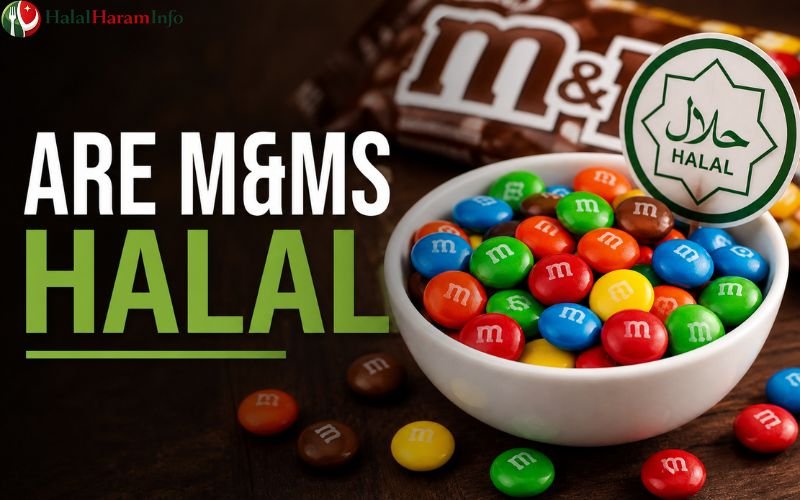
M&M’s are one of the most popular chocolate candies worldwide. Produced by Mars, Incorporated, they are known for their colorful candy shells and smooth chocolate centers. Found in supermarkets, vending machines, and convenience stores across the globe, they are enjoyed by people of all ages. For Muslim consumers, however, one important question remains: are M&M’s halal?
This question is not as simple as it may seem. While chocolate itself is generally halal, processed foods like M&M’s often contain additional ingredients that may raise concerns. These include emulsifiers, flavorings, and coloring agents, some of which may be derived from animal or alcohol-based sources. In addition, manufacturing practices and regional differences further complicate the issue.
This detailed guide explains the halal status of M&M’s, their ingredients, possible concerns, and how to make informed choices based on Islamic dietary guidelines.
What Are M&M’s?
M&M’s are small, round chocolates coated with a thin, crunchy sugar shell. The candy shell is brightly colored and often printed with a small “m,” making them easily recognizable. Since their introduction in the 1940s, M&M’s have expanded into a wide range of flavors and varieties.
Some of the most common types include:
Milk Chocolate M&M’s
Peanut M&M’s
Crispy M&M’s
Caramel M&M’s
Pretzel M&M’s
Peanut Butter M&M’s
Almond M&M’s
Seasonal and limited-edition flavors
Each type contains a slightly different combination of ingredients. While the core components—chocolate, sugar, and coatings—remain similar, added fillings and textures introduce new ingredients that may impact halal status. For example, crispy or pretzel varieties often include additional processing agents, while caramel-filled versions may contain more complex flavoring systems.
Understanding these differences is essential because even a small variation in ingredients can determine whether a product is halal, haram, or doubtful.
Quick Answer: Are M&M’s Halal?
The halal status of M&M’s is not universally clear-cut and depends on several factors, including ingredient sourcing, manufacturing processes, and regional production standards.
Some varieties may be halal if all ingredients are plant-based or sourced from halal-certified suppliers. Others may contain doubtful or non-halal ingredients, particularly when emulsifiers or flavorings are derived from animal or alcohol-based sources. Additionally, most M&M’s products are not officially halal-certified, which makes it difficult for consumers to be completely certain.
Because formulations vary by country, a product that appears acceptable in one region may not be the same in another. This is why it is important to check packaging, ingredient lists, and certification logos carefully rather than assuming all M&M’s are the same worldwide.
Key Ingredients in M&M’s
Understanding the ingredients is essential when evaluating whether a product is halal. While many components in M&M’s are generally permissible, some require closer inspection.
Common Ingredients
| Ingredient | Halal Status | Notes |
| Sugar | Halal | Generally permissible |
| Cocoa/Chocolate | Halal | Usually halal |
| Milk Powder | Halal | Must be from halal sources |
| Peanuts | Halal | Permissible |
| Cornstarch | Halal | Safe ingredient |
| Coloring Agents | Doubtful | Some may be animal-derived |
| Emulsifiers | Doubtful | Can be plant or animal-based |
| Flavorings | Doubtful | May contain alcohol traces |
Sugar and cocoa are naturally halal and widely accepted. Milk powder is also halal as long as it is not mixed with non-halal additives. However, ingredients like emulsifiers and flavorings introduce uncertainty because their sources are not always disclosed in detail.
Main Halal Concerns
1. Use of Emulsifiers (E471)
One of the most significant concerns in M&M’s is the presence of mono- and diglycerides (E471). These are used to improve texture, prevent separation, and enhance shelf life.
E471 can be derived from both plant and animal fats. If the source is plant-based, it is halal. However, if it comes from animal fat that is not slaughtered according to Islamic guidelines, it becomes non-halal. The challenge is that food labels usually do not specify the source, leaving consumers uncertain.
Because of this ambiguity, many scholars classify products containing E471 without clear sourcing information as mashbooh (doubtful).
2. Artificial Colors
Coloring agents are another area of concern. While many modern food dyes are synthetic, some may be derived from natural sources that are not halal.
For example, Carmine (E120) is derived from crushed insects and is considered non-halal by many scholars. Although not all M&M’s contain Carmine, the use of multiple colorants makes it important to verify each product individually.
Additionally, even synthetic colors may involve processing methods that include alcohol or other questionable substances, further complicating their halal status.
3. Flavorings and Additives
Flavorings are often listed simply as “natural” or “artificial,” without detailed explanation. These flavorings may use alcohol as a solvent or contain compounds derived from animal sources.
Even when alcohol is used in very small amounts during processing, its presence can raise concerns among strict halal consumers. While some scholars allow trace amounts that evaporate during manufacturing, others recommend avoiding such products altogether.
4. Cross-Contamination
M&M’s are manufactured in large facilities that may also process non-halal products. This creates a risk of cross-contamination, especially if shared equipment is used.
Although companies follow strict hygiene and safety standards, halal compliance requires more specific measures. Without dedicated halal production lines or certification, some consumers may choose to avoid such products to remain cautious.
Related Post: Is Cane’s Halal or Haram?
Are M&M’s Halal in Different Countries?
The halal status of M&M’s can vary significantly depending on where they are produced and sold.
United States
In the United States, most M&M’s products are not halal-certified. Ingredient transparency is limited, particularly regarding emulsifiers and flavorings. As a result, many Muslim consumers consider them doubtful.
United Kingdom and Europe
In the UK and Europe, some M&M’s products are labeled as suitable for vegetarians. This may indicate that certain animal-derived ingredients are not used. However, vegetarian labeling does not guarantee halal compliance, as alcohol-based flavorings and processing methods may still be present.
Middle East and Muslim-Majority Countries
In some Middle Eastern countries, imported or locally distributed M&M’s may carry halal certification. These products are more likely to meet halal standards, but consumers should still verify packaging carefully, as not all batches are the same.
Southeast Asia
Countries like Malaysia and Indonesia have stricter halal regulations, and some M&M’s products may be certified halal in these markets. However, availability varies, and imported versions may differ from locally approved ones.
Halal Certification Status
| Region | Halal Certified? | Recommendation |
| USA | No | Avoid if strict |
| UK/Europe | Rare | Check ingredients |
| Middle East | Sometimes | Look for halal logo |
| Southeast Asia | Occasionally | Verify packaging |
This table highlights the importance of regional differences. A product that is halal-certified in one country may not be the same elsewhere due to variations in sourcing and production.
Which M&M’s Might Be Halal-Friendly?
Some simpler varieties contain fewer complex ingredients and may be less likely to include non-halal components.
Potentially Safer Options
Plain Milk Chocolate M&M’s
Peanut M&M’s
These options rely on basic ingredients such as chocolate, sugar, and peanuts. However, even these are not guaranteed halal unless they carry official certification. The presence of emulsifiers and flavorings still requires verification.
Related Post: Is Kosher Halal or Haram?
Which M&M’s Are More Questionable?
More complex varieties are generally more likely to contain doubtful ingredients due to additional processing and flavoring.
Crispy M&M’s
Caramel M&M’s
Pretzel M&M’s
Peanut Butter M&M’s
Seasonal and specialty flavors
These products often include extra layers, fillings, or textures that require additional additives, increasing the likelihood of non-halal or questionable components.
How to Check If M&M’s Are Halal
Before purchasing M&M’s, it is important to take a few practical steps to ensure they meet halal requirements.
1. Look for Halal Certification
A recognized halal logo from a trusted authority is the most reliable indicator. Certification ensures that both ingredients and production processes meet Islamic standards.
2. Read the Ingredients List
Carefully review the ingredient list for emulsifiers like E471, vague “flavorings,” and unfamiliar additives. If the source is not clear, it is best to treat the product as doubtful.
3. Check Manufacturer Information
Visit the official website of Mars, Incorporated to review ingredient policies or regional product details. Some companies provide additional transparency online.
4. Contact Customer Support
Reaching out directly to the manufacturer can sometimes clarify whether specific ingredients are plant-based or halal-certified. While not always definitive, it can help reduce uncertainty.
Halal Alternatives to M&M’s
If you prefer to avoid doubtful products, there are many halal-certified alternatives available in the market.
Alternative Options
| Brand Type | Description |
| Halal-certified chocolates | Verified halal ingredients |
| Local halal sweets | Often clearly labeled |
| Homemade treats | Full control over ingredients |
Halal-certified chocolates offer the closest alternative in taste and convenience, while homemade treats provide complete assurance regarding ingredient sources.
Scholarly Opinions
Islamic scholars typically classify food products into three categories based on their ingredients and preparation.
Halal – Clearly permissible with verified ingredients
Haram – Contains prohibited substances such as pork or alcohol
Mashbooh (Doubtful) – Unclear or mixed sources
M&M’s often fall into the mashbooh category, particularly in regions where ingredient sourcing is not clearly disclosed. Many scholars advise avoiding doubtful items when halal alternatives are available, based on the principle of caution in dietary matters.
Related Post: Is Sour Patch Kids Halal or Haram?
FAQs
Are all M&M’s haram?
No, not all M&M’s are explicitly haram. However, many are considered doubtful due to unclear ingredient sourcing and lack of halal certification.
Do M&M’s contain gelatin?
Most standard M&M’s do not contain gelatin. However, some specialty or limited-edition products may include additional ingredients, so it is important to check labels carefully.
Are M&M’s vegetarian?
Some M&M’s products are labeled vegetarian, especially in Europe. However, vegetarian status does not automatically mean halal, as alcohol-based flavorings and processing aids may still be used.
Can Muslims eat M&M’s?
Muslims can consume M&M’s only if the product is confirmed halal or free from doubtful ingredients. Otherwise, it is safer to avoid them.
Are peanut M&M’s halal?
Peanut M&M’s may be among the safer options due to simpler ingredients, but they are still not guaranteed halal without certification.
Is there alcohol in M&M’s?
Alcohol is not typically listed as a direct ingredient, but it may be used in flavor processing in small amounts. This can be a concern for strict halal consumers.
Are M&M’s halal in Pakistan?
Most imported M&M’s available in Pakistan are not halal-certified. Consumers should carefully check packaging and consider certified alternatives for greater assurance.
Final Verdict
M&M’s are not universally halal-certified, and their ingredients can vary depending on the region and product type. While some varieties may appear permissible, the presence of uncertain emulsifiers, flavorings, and possible cross-contamination makes them questionable for strict halal diets.
Summary
Not officially halal-certified in most countries
Some ingredients may be doubtful
Safer to consume only if halal-certified
Better to choose verified halal alternatives
Conclusion
If you are strict about halal consumption, it is best to avoid M&M’s unless they carry a trusted halal certification. For those who are more flexible, reviewing ingredient lists and choosing simpler varieties may help reduce concerns.
When uncertainty exists, choosing clearly halal-certified products is always the safest and most reliable approach.
